Butterfly Doodles: A Playful, Spring-Inspired Dingbat Font for Real Creative Work
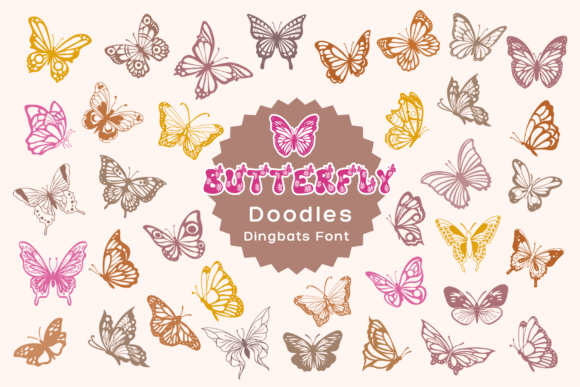
There’s a quiet magic in fonts that don’t just say something—but feel like something. Butterfly Doodles is one of those rare typefaces that lands with warmth, lightness, and unmistakable seasonal charm. It’s not a traditional alphabet font. Instead, it’s a dingbats font—a curated collection of hand-drawn butterfly motifs, floral accents, delicate swirls, and spring-themed glyphs, all designed to function as expressive visual elements rather than letters.
What makes Butterfly Doodles especially useful isn’t just its aesthetic—it’s how effortlessly it integrates into real-world creative workflows. Whether you're designing a rustic-chic wedding invitation or sketching label concepts for an organic skincare line, this font delivers instant atmosphere without demanding hours of custom illustration.
Why Dingbats Still Matter in a Digital-First World
In an era dominated by variable fonts and AI-generated assets, the enduring appeal of dingbats like Butterfly Doodles might seem surprising. But their value lies in their intentionality. Unlike clipart or generic SVG packs, Butterfly Doodles is carefully spaced, consistently weighted, and optimized for typographic harmony. Each glyph scales cleanly, aligns predictably, and retains character at sizes from 8 pt (for subtle background texture) to 200 pt (for bold signage or wall art).
Designers reach for dingbats when they need visual rhythm—not filler. A single butterfly glyph can serve as a bullet point in a minimalist DIY tutorial. A cluster of three, rotated and layered, becomes a custom divider in a digital newsletter. And because Butterfly Doodles was built with springtime in mind—think budding branches, fluttering wings, soft petals—it carries emotional resonance that stock vectors often lack.
Where Butterfly Doodles Shines: Practical Use Cases
This isn’t a font for body text or legal disclaimers. Butterfly Doodles thrives where personality matters most. Here’s where it delivers tangible impact:
- Wedding invitations & stationery: Use the larger butterfly glyphs as corner flourishes on save-the-dates, or insert smaller ones between names on place cards. Their organic flow complements watercolor backdrops and linen textures beautifully.
- Product packaging & labels: Small-batch makers love Butterfly Doodles for jar labels (honey, herbal tea, bath salts), greeting cards, and candle tags. The whimsy feels handmade—even when printed digitally.
- Branding & logos: While not suitable as a primary logotype, Butterfly Doodles excels as a supporting element—think of it as your brand’s “visual whisper.” Pair it with a clean sans-serif headline, and let a single butterfly glyph anchor your favicon or social media icon.
- Posters & quotes: Overlay a butterfly glyph over a soft gradient background, then add an inspirational quote in a contrasting serif. Instant poster—no illustrator skills required.
- Book covers & editorial design: Especially effective for memoirs, poetry collections, or children’s books with nature themes. A subtle border made from repeating Butterfly Doodles glyphs adds sophistication without clutter.
How It Fits Into Modern Design Tools & Workflows
You don’t need advanced software to use Butterfly Doodles effectively. It’s a standard OpenType font (.otf), so it loads instantly in Adobe Creative Cloud apps, Affinity Designer, Canva Pro, and even free tools like GIMP or Inkscape (with proper font installation). No plugins. No subscriptions.
Because it’s a dingbats font—not a decorative script—you get full keyboard access. Press “A” to insert a small monarch, “B” for a sprig of lavender, “C” for a curled tendril. That means rapid iteration: try five layout variations in under two minutes. No dragging, no resizing, no hunting through folders for the right SVG.
For crafters and educators, this accessibility is transformative. A teacher printing classroom posters can type a row of butterflies as bullet points for a spring science unit. A scrapbooker can build borders directly in Word or Google Docs before exporting to PDF for printing.
What to Consider Before Using Butterfly Doodles
Like any specialized tool, Butterfly Doodles works best when matched to the right context. Here are practical considerations designers and creators commonly weigh:
- Licensing: Always verify usage rights. Most versions of Butterfly Doodles permit commercial use—including resale items like printable planners or SVG cut files—but check the license file included with your download. Some free variants restrict use on physical products sold in volume.
- Color flexibility: Since Butterfly Doodles is vector-based, it scales infinitely and supports full color control. You’re not locked into black outlines. Fill a butterfly with a soft peach gradient, stroke it in sage green, or set it to 30% opacity for a watermark effect.
- Pairing strategy: This font sings when contrasted—not matched. Avoid pairing it with other decorative or overly ornate typefaces. Instead, lean into clarity: use Montserrat for headlines, Lora for body copy, or even Roboto for modern minimalism. Let Butterfly Doodles be the accent—not the anchor.
- Audience alignment: Its springtime energy resonates strongly with audiences aged 25–55 who appreciate artisanal aesthetics, sustainability, and gentle optimism. It may feel out of place in high-tech, corporate, or ultra-masculine branding contexts—unless used with deliberate irony or subversion.
Small Tweaks, Big Impact: Pro Tips for Everyday Use
You don’t need a design degree to elevate your projects with Butterfly Doodles. Try these low-effort, high-return techniques:
- Create custom dividers: Type three butterfly glyphs, adjust tracking to -50, then duplicate and flip vertically. Instant symmetrical frame for blog headers or Instagram story highlights.
- Build texture overlays: Set Butterfly Doodles to 8 pt, fill with light gray, and scatter across a white background at 5% opacity. Print-ready paper texture—done in 10 seconds.
- Turn glyphs into icons: Copy a favorite glyph, paste into Illustrator, and use Image Trace to convert to editable vector paths. Now you can recolor individual wings or isolate parts for embroidery patterns.
- Use as signature flair: Add a tiny butterfly after your name in email signatures or business cards. Not cutesy—just quietly distinctive.
More Than Just “Cute”: The Emotional Utility of Butterfly Doodles
Design isn’t only about function or legibility. It’s about signaling tone, inviting emotion, and building connection. Butterfly Doodles taps into deeply rooted associations: transformation, lightness, renewal, gentleness. That’s why it shows up so often in wellness branding, eco-conscious startups, and mental health resources—not as decoration, but as visual empathy.
It doesn’t shout. It flutters. And in a world saturated with aggressive visuals and algorithm-driven noise, that kind of quiet intentionality is increasingly rare—and increasingly valuable.
So whether you’re hand-lettering a thank-you note, prototyping a new tea brand, or designing signage for a community garden, Butterfly Doodles offers more than ornamentation. It offers a mood. A pause. A breath of spring—ready to deploy, one glyph at a time.